When the Control BI Fails: What It Means and What to Do Next
In the world of dental sterilization assurance, biological indicators (BIs) are the most reliable method of verifying whether a sterilizer is functioning effectively. These indicators test the true effectiveness of a sterilization cycle by challenging it with highly resistant bacterial spores. But what happens when it's not the test BI that fails, but the control BI?
While a failed test BI raises red flags for a potential sterilization breach, a failed control BI introduces an entirely different set of concerns. This article breaks down what a control BI is, what its failure means, and the exact steps your office should take to investigate and correct the issue.
What is a Control BI?
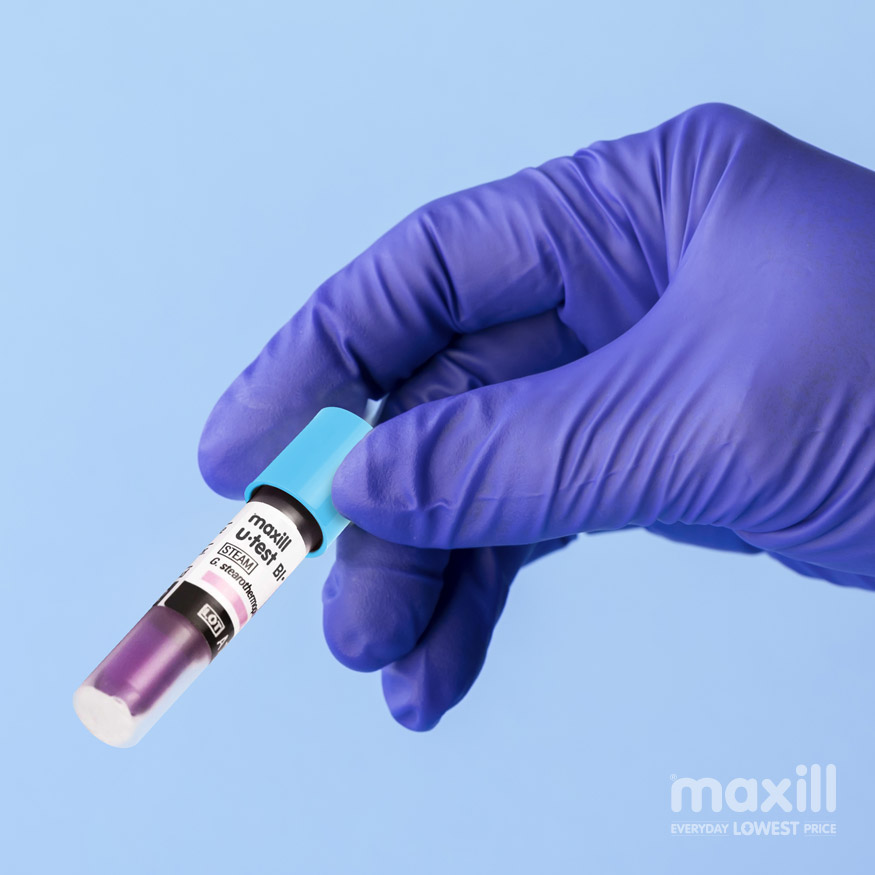
A Control BI is a self-contained biological indicator that is not exposed to the sterilization process. Its job is to serve as a positive control to prove that the spores used in the test BI are viable and that the incubation system is functioning properly.
The organism inside most steam sterilization BIs is the Geobacillus stearothermophilus, a thermophilic, spore-forming bacterium known for its resistance to moist heat. Each BI contains this organism in spore form along with a growth medium containing a pH-sensitive dye (purple before activation and incubation).
Expected Results from a Control BI
A functioning control BI should:
- Be activated (ampoule crushed) before incubation.
- Turn yellow and become turbid within 24-48 hours at 55-60°C.
- This confirms:
- The spores are viable (alive).
- The incubator is maintaining the correct environment for microbial growth.
- The BI product and batch are reliable.
What is a Failed Control BI?
A failed control BI is one that does not change colour and remains purple after the incubation period. This means no microbial growth occurred, which is not expected since the spores were not sterilized.
***Important: A failed control BI does NOT indicate a sterilization failure.***
If your test BI passed (stayed purple) and the control BI failed (also stayed purple), this is not considered an IPAC breach but it is a quality assurance problem that must be addressed immediately.
Why Did the Control BI Fail? Possible Causes
Here are the most common reasons:
- The Control BI Was Not Activated
- Was the ampoule crushed before incubation?
- If not, the spores and the medium never mix, so no growth can occur, even if the spores are viable.
- This results in a false negative outcome.
- The Incubator Is Not Working
- Is the incubator maintaining the correct temperature (usually 55-60°C)?
- A malfunctioning incubator can prevent spore growth, leading to failed results.
- Try incubating a known viable control BI from a different batch.
- BI Expired or Improperly Stored
- Check the expiration date.
- Ensure BIs were stored as per manufacturer recommendations (away from heat, light, and humidity).
- Improper storage may damage spores and reduce viability.
- Defective or Non-viable BI Lot
- Sometimes the issue is with the lot itself.
- Consider testing another control BI from the same and a different lot.
- Contact the manufacturer if the issue persists.
Immediate Action Steps
If your control BI fails:
- Document the incident clearly, including:
- The date and time of incubation
- Lot number of the BI
- Incubator temperature
- Who activated and placed the BI
- Repeat the BI test using a new set (test + control) from a different lot if possible.
- Verify incubator function, including temperature logs and power supply.
- Review BI storage conditions to ensure viability hasn't been compromised.
- Educate your team about the importance of properly activating BIs before incubation.
What If It Was a New Team Member? An Existing Team Member?
This scenario highlights the importance of training. Without proper training the risk of disseminating misinformation increases. In fact, anyone supporting IPAC decisions should have formal training. Relying on past experience as a dental professional is not enough. Practices often carry forward outdated habits that are no longer compliant.
Final Thoughts
A failed control BI doesn't mean your sterilizer is broken—but it does mean something is off in your quality assurance process. As long as your test BI passes and your documentation is complete, there is no immediate risk to client safety. However, failure to address why the control BI didn't grow could compromise the integrity of your monitoring program long-term.
If your office struggles to troubleshoot these results confidently, consider formal training options like the maxill University in-office course Sterilization Monitoring and Fanshawe College IPAC course, which covers sterilization monitoring in detail. Solid training is the foundation of strong infection control, and your clients deserve nothing less.

Michelle Aubé (Simmonds) RDH, maxill Dental Hygiene Educator
Michelle is a Dental Hygiene Speaker, Consultant and Educator with over 30 years of experience as a RDH and 4 years as a CDA. She is a professor and curriculum writer at Fanshawe College in both the dental hygiene and continuing education program sharing her knowledge in IPAC, professional practice, periodontal classification, social justice, advocacy and clinical applications. She is maxill's CE and IPAC Director and wears various IPAC hats including auditing federal correctional facilities dental clinics for IPAC standards. Michelle is ODHA's Regional Board Director and authors articles for CDHA's OH Canada professional publication and continues to practice clinically in London ON. She is a CDHO IPAC Remedial Facilitator and IPAC Expert Opinion. Her strong ethics has allowed her to serve on the Discipline Committee at Algonquin College and hold the position of a CDHO Quality Assurance Assessor for 7 years. As a lifelong learner she is completing a BA in Adult Education at Brock University. Her diverse dental background and current status as a practicing RDH offer a fulsome and realistic view of dental-related topics. As a passionate champion for the profession, she advocates for equity, professional autonomy, and systemic change, true grassroots leadership at its finest.
Michelle can be reached at [email protected]
Thanks for reading our latest blog article! If you've got a topic you'd like to see us tackle next, please submit your suggestion to our blog writing team of dental professionals at [email protected].