

The Partition Problem: Where Separation Really Belongs in Dental Reprocessing
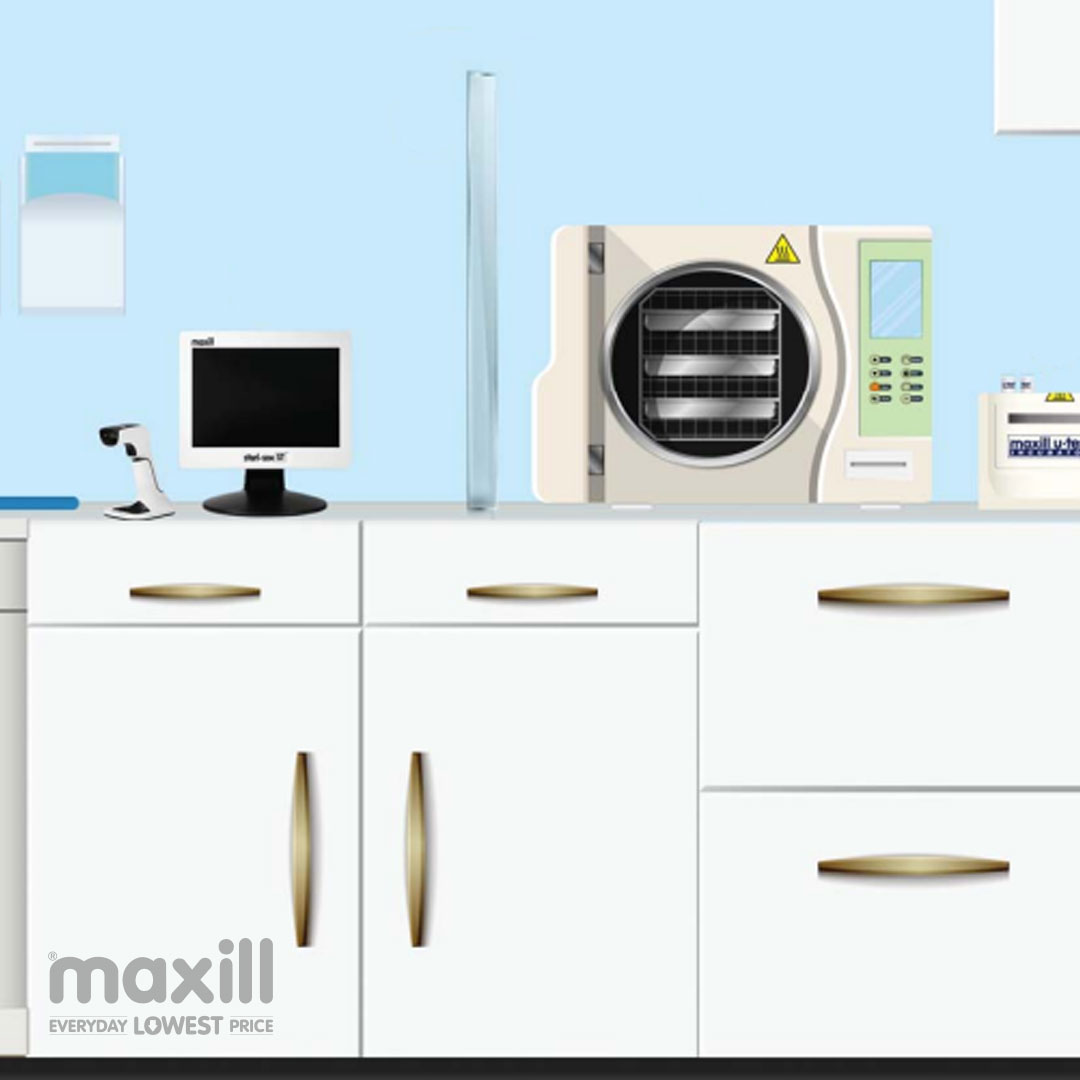
Instrument reprocessing in the dental office does not need to be complicated to be effective. In fact, the simplest workflows are often the safest, especially in today's dental landscape where reprocessing tasks may be performed by individuals without formal dental or infection prevention training.
At the centre of effective reprocessing is a clear, one-way workflow... moving instruments from non-sterile to sterile without confusion, crossover, or unnecessary handling.

Why Language Matters in the Reprocessing Area
During audits, reprocessing spaces are often described using terms such as:
- Decontamination area
- Clean area
- Sterile area
While these terms may appear interchangeable, many dental offices have intentionally moved away from the word "clean" when designing their workflow.
Clean does not mean sterile.
In busy practices, particularly those with temporary staff, cross-trained team members, or non-clinical personnel assisting with reprocessing, the word clean can unintentionally create false reassurance. An instrument may look clean but has not yet completed sterilization and is not ready for patient use.
For this reason, many offices now use simple, unambiguous signage:
- NON-STERILE
- STERILE
This language removes interpretation and serves as a constant visual cue supporting one-way workflow and correct decision-making.
Why This Is Not a Hypothetical Discussion
This discussion is not theoretical.
On several occasions during audits and site visits, I have personally witnessed staff interpret the word clean to mean sterile. In these situations, instruments were removed from the sterilizer and placed back into the opposite direction of the one-way workflow, specifically into bins labelled "clean."
This breakdown did not occur due to negligence, but due to language confusion. When terminology is open to interpretation, workflow errors become more likely, particularly in environments where multiple team members with varying levels of training participate in reprocessing.
Clear, unambiguous language and visual cues are not cosmetic choices, they are critical controls that protect workflow integrity, patient safety, and audit defensibility.
Separation Is Required... but Where?
Dental offices are routinely advised during audits that contaminated areas must be physically separated from sterile areas. Most practices have reasonably interpreted this to mean a clear separation point before the sterilizer, the moment where instruments transition from non-sterile handling to sterile processing.
That separation point is logical. It aligns with workflow. And it supports safety.
However, during some live audits, offices are now being asked to introduce an additional partition after the sink. This is where confusion, and risk, can begin.
Understanding the Decontamination Zone
In a dental reprocessing workflow, decontamination includes:
- Receiving contaminated instruments
- Ultrasonic cleaning
- Manual cleaning
- Rinsing
All of these steps involve handling contaminated instruments.
The sink is not a transition point. It is part of the non-sterile (decontamination) zone. Separation is intended to occur after decontamination is complete, not mid-process. Keeping in mind decontamination also includes drying the instruments and inspecting them to decide if they are going back to square one for a 2nd round of cleaning. This all happens after the sink on lint free towels before they move to packaging.
It is important to clarify that many dental offices already have a physical partition in place after cleaning is complete and before packaging begins. This separation supports a one-way workflow and clearly distinguishes non-sterile handling from controlled processing steps. In these layouts, the partition does not interrupt manual cleaning or rinsing at the sink but instead marks the appropriate transition point between decontamination and preparation for sterilization.
The concern arises when partitions are introduced mid-process, such as immediately after the sink, where they interfere with safe instrument movement rather than supporting workflow integrity.
The Practical Problem with a Partition After the Sink
A typical workflow looks like this:
- Ultrasonic bath
- Sink (manual cleaning and rinsing)
- Basket removed
- Instruments placed on a towel or drying surface
- Inspection, packaging, sterilization
Introducing a partition immediately after the sink raises an important question:
How are instruments expected to move forward safely?
- Lifting wet baskets over a barrier
- Passing heavy cassettes across a partition
- Reaching awkwardly around an obstruction
These actions increase:
- Drop risk
- Splashing
- Sharps injury risk
- Musculoskeletal strain
A control meant to reduce infection risk can unintentionally create occupational health and safety concerns.
Splashing and Spraying: Yes, This Must Be Considered
Absolutely, splashing and spraying are legitimate concerns in reprocessing areas and must be accounted for during audits.
However, these risks must be evaluated in context, not assumed by default.
One rationale sometimes offered for a post-sink partition is concern that manual cleaning could splash onto packaged instruments.
That concern assumes:
- Packaged instruments are present in large volumes
- They are staged or stored adjacent to the sink
In dental offices with controlled inventory, this scenario should not exist.
Packaged instruments:
- Should not accumulate beside sinks
- Should not be staged in decontamination zones
- Should move promptly into sterilization or designated sterile storage
When inventory management is appropriate, this is not a realistic risk.
Manual Cleaning Is Designed to Control Splashing
Manual cleaning protocols are intentionally designed to contain contamination, not spread it.
Best practice includes:
- No running water during scrubbing
- Use of a basin placed within the sink
- Minimal water volume
- Scrubbing performed below the water line
- Controlled movements at the bottom of the sink
When performed correctly:
- Splashing is minimized
- Aerosols are controlled
- Contamination remains contained within the sink
If excessive splashing is occurring, the issue is not the absence of a second partition — it is technique, training, or process compliance.
Partitions Are Not a Substitute for Proper Practice
Adding physical barriers to compensate for:
- Improper manual cleaning technique
- Use of running water
- Inadequate staff training
does not reduce risk — it relocates it.
Worse, it can introduce:
- Unsafe handling of wet instruments
- Increased reach and lift hazards
- Workflow disruption
- New injury risks
IPAC controls should support safe practice, not obstruct it.
A Balanced, Defensible Approach
A realistic and defensible reprocessing layout should:
- Treat the entire sink zone as non-sterile
- Maintain one clear separation point before sterilization
- Support ergonomic, safe movement of instruments
- Use non-sterile / sterile signage
- Reflect real-world dental reprocessing, not theoretical layouts
Final Thought
Infection prevention is about risk reduction, not risk stacking.
Clear separation is essential.
Clear language is critical.
But controls must remain practical, safe, and purposeful.
When workflows are designed thoughtfully, and practices follow proper technique, the system works as intended.
Simple. Clear. Defensible.

Michelle Aubé (Simmonds) RDH, maxill Dental Hygiene Educator
Michelle is a Dental Hygiene Speaker, Consultant and Educator with over 30 years of experience as a RDH and 4 years as a CDA. She is a professor and curriculum writer at Fanshawe College in both the dental hygiene and continuing education program sharing her knowledge in IPAC, professional practice, periodontal classification, social justice, advocacy and clinical applications. She is maxill's CE and IPAC Director and wears various IPAC hats including auditing federal correctional facilities dental clinics for IPAC standards. Michelle is ODHA's Regional Board Director and authors articles for CDHA's OH Canada professional publication and continues to practice clinically in London ON. She is a CDHO IPAC Remedial Facilitator and IPAC Expert Opinion. Her strong ethics has allowed her to serve on the Discipline Committee at Algonquin College and hold the position of a CDHO Quality Assurance Assessor for 7 years. As a lifelong learner she is completing a BA in Adult Education at Brock University. Her diverse dental background and current status as a practicing RDH offer a fulsome and realistic view of dental-related topics. As a passionate champion for the profession, she advocates for equity, professional autonomy, and systemic change, true grassroots leadership at its finest.
Michelle can be reached at [email protected]
Thanks for reading our latest blog article! If you've got a topic you'd like to see us tackle next, please submit your suggestion to our blog writing team of dental professionals at [email protected].