
What If Your IPAC Manual Only Cost You $9/Day… for One Year Only? Is $9/Day Worth Peace of Mind and Being Audit-Ready?

Let's be honest: dental offices are constantly being asked to invest in something, equipment, supplies, staffing, software, repairs, continuing education... the list never ends.
So, when an office hears the price of a professionally built IPAC program, the first reaction is often:
"Can we get a discount?"
And I get it.
But here's the better question:
So... what if it only cost $9/day... for one year only?
Is $9 worth peace of mind?
Why clinics shop an IPAC manual like it's a box of gloves (and why it isn't)
When clinics ask for discounts, it's not always because they don't care about IPAC.
Most of the time, it's because they don't realize what they're actually buying.
Because an IPAC manual is not a box of gloves.
It's not a commodity.
It's not something you compare like price tags on supplies.
A strong IPAC program is a system designed to protect your patients, your team, your license, and your clinic reputation.
Yes, it checks the "manual required" box... but that's not the real value
Of course, a written IPAC policy and procedure manual is required. Regulatory bodies expect it and inspections ask for it.
But if the manual is only being judged on its existence — as a check-box item — it will always feel expensive.
Because a manual sitting untouched looks like paper.
A manual that's used properly becomes an indispensable tool your team relies on.
So, what makes a high-quality IPAC program different?
A premium IPAC program isn't "just a manual." It's built for real dental clinic workflows.
It includes two comprehensive binders:
- an IPAC Manual
- a MIFU Binder (Manufacturer Instructions for Use)
And it includes a key step many offices don't realize matters:
The data extraction visit
This process does not rely on you simply emailing the name of your sterilizer and a few pieces of equipment.
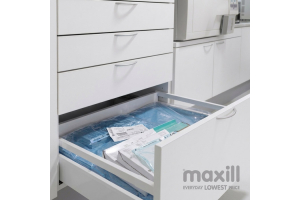
We review your clinic's real workflow, products, equipment, and processes — including opening cupboards and drawers — so the final program is tailored to your clinic and actually makes sense for your team. This also means you're supported by a real person working one-on-one with you — not generic templates, and not AI support. You receive guidance from an experienced IPAC professional with extensive knowledge specific to the dental environment.
That's how it becomes defensible.
That's how it becomes audit ready.
The manual only works if your team can access it
Where the manual lives matters.
I've returned to offices a year later to update their manual... and it's sitting in the exact same place it was dropped off.
Best practice looks like this:
- the paper manual is kept in a central, accessible location
- the digital version is saved on every computer in every operatory
Because when someone needs an answer, they need it immediately... not after guessing.
How your team should use the manual (every year, not just during inspections)
A well-built IPAC manual supports real daily operations, including:
- onboarding new employees
- guiding temps who need answers quickly
- performance expectations (for both employer and employee)
- self-assessment and reflection
- yearly training and refreshers
This is where the value lives.
So... what if it only cost $9/day... for one year only?
If you spread the investment across a year, it works out to $291.67/month, $67.31/week or $9.59/day.
That's $9/day for consistency, clarity, confidence, and audit readiness.
Because peace of mind doesn't come from owning a manual.
It comes from using it.

Michelle Aubé (Simmonds) RDH, maxill Dental Hygiene Educator
Michelle is a Dental Hygiene Speaker, Consultant and Educator with over 30 years of experience as a RDH and 4 years as a CDA. She is a professor and curriculum writer at Fanshawe College in both the dental hygiene and continuing education program sharing her knowledge in IPAC, professional practice, periodontal classification, social justice, advocacy and clinical applications. She is maxill's CE and IPAC Director and wears various IPAC hats including auditing federal correctional facilities dental clinics for IPAC standards. Michelle is ODHA's Regional Board Director and authors articles for CDHA's OH Canada professional publication and continues to practice clinically in London ON. She is a CDHO IPAC Remedial Facilitator and IPAC Expert Opinion. Her strong ethics has allowed her to serve on the Discipline Committee at Algonquin College and hold the position of a CDHO Quality Assurance Assessor for 7 years. As a lifelong learner she is completing a BA in Adult Education at Brock University. Her diverse dental background and current status as a practicing RDH offer a fulsome and realistic view of dental-related topics. As a passionate champion for the profession, she advocates for equity, professional autonomy, and systemic change, true grassroots leadership at its finest.
Michelle can be reached at [email protected]
Thanks for reading our latest blog article! If you've got a topic you'd like to see us tackle next, please submit your suggestion to our blog writing team of dental professionals at [email protected].